Homeowners facing a refrigerant leak often hear that their indoor cooling coil has failed. This repair presents a critical financial crossroad.
The decision involves evaluating equipment age, refrigerant chemical standards, and seasonal energy efficiency ratios (SEER2). Replacing only a single component can sometimes trigger secondary failures in older equipment.
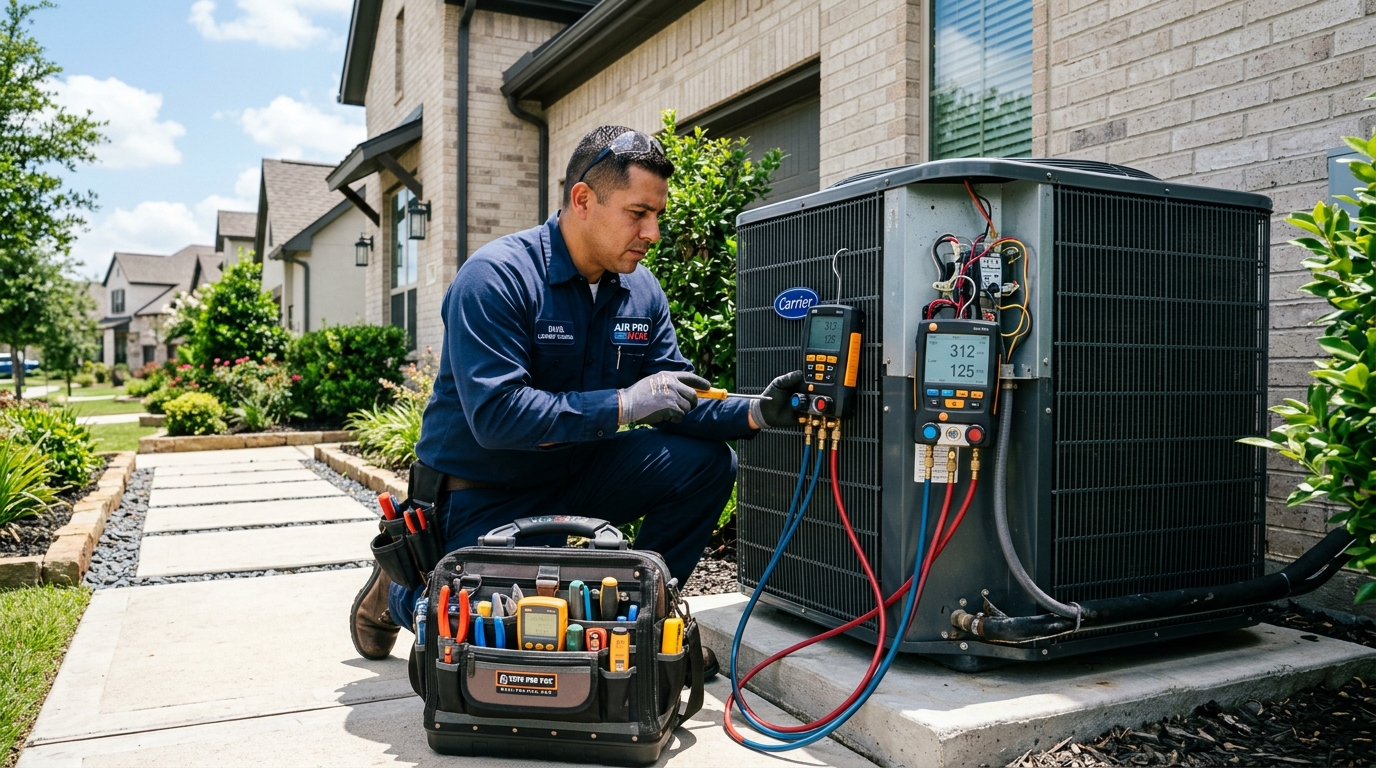
Understanding Air Conditioner A-Coils and Heat Exchange
Modern central cooling systems operate as split systems. The indoor section contains the evaporator coil and blower assembly, while the outdoor section houses the compressor and condenser.
The evaporator coil acts as the primary heat absorption point. Liquid refrigerant enters the coil through a thermal expansion valve (TXV), dropping in pressure and boiling into vapor to extract sensible and latent heat.
When an evaporator coil develops pinhole leaks, refrigerant escapes into the attic or closet. This loss drops suction pressure, causing ice accumulation along the suction line and suffocating airflow across your home.
The 50 Percent Rule: Financial Repair vs Replacement Calculation
Applying mathematical discipline eliminates guesswork when contractors provide diagnostic repair estimates. An evaporator coil replacement often runs between $1,400 and $2,800 out of warranty.
Consider an air conditioning unit that is 9 years old facing a $2,200 coil replacement. Multiplying $2,200 by 9 equals $19,800, well past the $5,000 threshold.
Investing major capital into an aged unit leaves you vulnerable. The outdoor compressor, fan motor, and contactor remain 9 years old, and their eventual breakdown will double your total out-of-pocket expenses.
Coil Replacement Cost vs Whole HVAC System Replacement
Review the itemized cost and performance differences between replacing a standalone evaporator coil and investing in a matched cooling system.
| Evaluation Factor | Evaporator Coil Only | Complete Split System |
|---|---|---|
| Typical Out-of-Pocket Cost | $1,400 - $2,800 | $6,800 - $11,500 |
| Warranty Coverage | 1 to 5 years (replacement part only) | 10 years parts, compressor, and coils |
| Refrigerant Compatibility | Locked to existing system chemical | New generation EPA compliant (R-454B / R-32) |
| Energy Efficiency Impact | Maintains legacy SEER rating | Upgrades to 15.2 to 18+ SEER2 ratings |
| Risk of Secondary Breakdown | High (outdoor compressor remains aged) | Very low (all mechanical components are new) |
While replacing the coil requires less upfront cash, homeowners in hot climates often find that complete system replacement yields lower utility bills and eliminates unexpected emergency service calls.
Unsure If Your System Qualifies for Coil Replacement?
Our licensed technicians perform complete pressure testing, SEER2 load calculations, and honest repair-versus-replace consultations across Pflugerville and surrounding Travis County.
Call for Professional Diagnostic: (888) 217-8281Refrigerant Transitions: R-410A Phaseout and A2L Compatibility
Refrigerant regulatory mandates play a major role in HVAC lifecycle decisions. Legacy R-22 Freon systems are completely obsolete, making coil replacement economically irrational on units using R-22.
Current R-410A production quotas are decreasing rapidly. As supplies tighten, purchasing virgin R-410A to recharge an older system after coil replacement will cost significantly more per pound.
Modern A2L refrigerants operate at different pressure-temperature curves and require factory-installed leak detection sensors. New evaporator coils cannot simply be cross-charged with different refrigerants without severe safety and warranty violations.
Why Mismatched Coils and Condensers Fail in Texas Heat
Air conditioning manufacturers design split systems as matched sets. The indoor evaporator coil and outdoor condenser are engineered with identical volumetric displacement and heat transfer capacities.
When you install a brand-new 15 SEER2 evaporator coil onto a 12-year-old 13 SEER outdoor condenser, the expansion valve cannot maintain optimal superheat and subcooling.
During extreme summer afternoons in Central Texas, where outdoor temperatures frequently exceed 100 degrees, mismatched equipment runs continuously. High head pressure strains internal motor windings, causing total compressor seizure within 12 to 24 months of coil installation.
If your system experiences continuous runtime or uneven temperatures, exploring a dedicated complete HVAC replacement provides balanced cooling and protects your long-term investment.
Frequently Asked Questions About AC Coil Replacement
How much does it cost to replace an AC evaporator coil?
Labor comprises a significant portion of this expense because the technician must recover refrigerant, unbraze line connections, slide the heavy coil from the air handler, braze the new unit with nitrogen flow, and pull a 500-micron deep vacuum.
Can I replace just the indoor evaporator coil without replacing the outdoor unit?
Technicians must verify that the replacement coil features an engineered thermal expansion valve matched to the displacement capacity of your existing outdoor scroll compressor.
How long does an air conditioner evaporator coil typically last?
Regular maintenance, including annual cleaning and prompt air filter replacements, prevents acidic grime from etching into the copper tubing and extending coil longevity.
What causes an AC evaporator coil to leak refrigerant?
Modern manufacturers utilize all-aluminum evaporator coils to eliminate galvanic reactions and formicary pitting, significantly reducing refrigerant leak occurrences.
Need Fast Diagnostic Help in Pflugerville?
Schedule a professional diagnostic assessment with our certified team. We provide transparent upfront pricing, electronic refrigerant leak detection, and honest equipment evaluations.
Schedule Diagnostic Visit: (888) 217-8281