The compressor serves as the mechanical heart of your residential air conditioning system. When this component begins to fail, the entire refrigeration cycle collapses.
Recognizing early failure symptoms allows homeowners to address electrical issues before the compressor experiences catastrophic burnout, which distributes corrosive acid throughout the line-set.
How an Air Conditioner Hermetic Scroll Compressor Works
In modern residential split systems, the compressor resides inside the outdoor condensing unit. It operates sealed inside a welded steel shell bathed in specialized synthetic polyolester (POE) oil.
The motor windings draw 240-volt single-phase electricity, relying on a dual run capacitor to supply startup torque.
If refrigerant leaks occur or air filters become clogged, liquid refrigerant floods the compressor, or superheated gas fails to cool the motor windings, leading to mechanical friction and eventual failure.
The 7 Warning Signs Your AC Compressor Is Failing
1. Outdoor Unit Hums or Buzzes but the Compressor Fails to Start
Homeowners often mistake this hum for normal operation because the top fan continues to blow air. However, the air emerging from the top of the outdoor unit will feel ambient rather than hot, indicating that no heat extraction is occurring.
2. Warm Air Discharging from Indoor Supply Registers
Check your outdoor unit immediately. If the indoor thermostat displays a cooling call but the outdoor compressor remains silent or cold to the touch, internal safety controls have shut it down.
3. Tripping the Outdoor 240V Circuit Breaker on Startup
Never reset a tripped HVAC breaker more than once. Continuing to force power to a grounded compressor can melt terminal pins, cause terminal venting, and create a fire hazard.
4. Grinding, Rattling, or Squealing Mechanical Noises
These sounds signify advanced mechanical breakdown. Shut off power at the outdoor disconnect box immediately to prevent shattered metal fragments from entering the copper tubing.
5. Continuous Runtime Without Reaching Thermostat Setpoint
Technicians verify this condition using digital manifold gauges to measure the difference between suction pressure and head pressure under load.
6. Hard Starting and Severe Cabinet Shuddering
Central Texas heat waves exacerbate hard starting because outdoor temperatures keep condensing pressures exceptionally elevated between operational cycles.
7. Pungent Burnt Electrical Smell Around the Condenser
This failure requires extensive line-set decontamination, acid-neutralizing flushing, and dual filter-drier installation before any new equipment can be commissioned safely.
Suspecting a Seized or Burned-Out AC Compressor?
Our TDLR-licensed Pflugerville technicians carry digital megohmmeters, clamp meters, and factory diagnostic instruments for rapid, definitive testing.
Call for 24/7 Emergency Dispatch: (888) 217-8281Electrical Testing Protocols: RLA, LRA, and Megohmmeter Checks
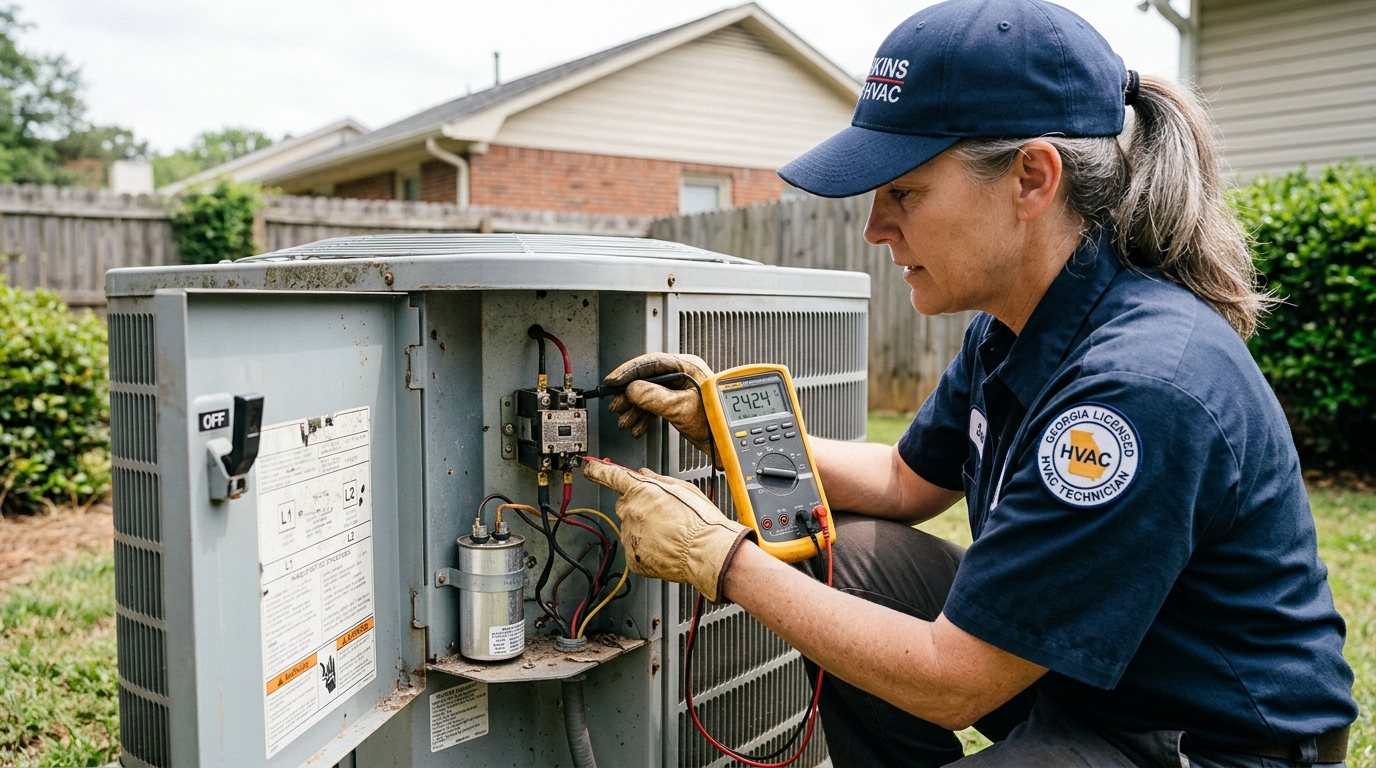
Professional diagnostic testing removes all ambiguity regarding compressor health. A technician begins by measuring resistance across the Common, Start, and Run terminals.
The sum of resistance from Common-to-Start and Common-to-Run must equal the resistance between Start and Run. Any deviation reveals an open winding.
Testing each pin directly to bare copper confirms whether a winding has shorted to ground. A resistance reading below 20 megohms on a megger proves winding insulation failure, confirming the compressor has reached end-of-life.
Acid Washout: What Happens During an Electrical Burnout?
Simply bolting in a replacement compressor without chemical remediation guarantees rapid repeat failure. Acidic sludge coats the inner walls of the indoor evaporator coil and copper lines.
Technicians conduct an oil acid test using chemical test strips. Remediation requires flushing with specialized solvent, replacing the liquid line drier, and installing a high-capacity suction line burnout filter-drier.
For aged systems that suffer an acidic burnout, homeowners often find that a full emergency AC repair or system replacement provides better financial security than piecemeal repairs.
Frequently Asked Questions About Bad AC Compressors
How do you know if an AC compressor is bad?
A certified technician confirms compressor status using a digital multimeter to measure winding continuity, winding resistance, and amp draw under load.
Can an AC compressor be repaired, or does it have to be replaced?
External components like the contactor, start capacitor, run capacitor, and hard start kit can be replaced individually if the compressor itself remains electrically and mechanically sound.
How much does it cost to replace a residential AC compressor?
Because labor and refrigerant costs represent a large investment, systems over 10 to 12 years old are generally better candidates for whole-system replacement.
How long will an air conditioner run with a bad compressor?
As soon as you notice clicking, humming, or tripping breakers, shut off power at the thermostat to protect your broader electrical infrastructure.
Get an Honest Compressor Assessment in Pflugerville
Don't let an unverified diagnostic leave you in the heat. Our technicians provide verified megger testing, warranty checks, and clear repair solutions.
Schedule Diagnostic Service: (888) 217-8281