How Central Texas Taylor Marl Clay Shifts Cause HVAC Line-Set Refrigerant Leaks in Pflugerville
Published by Master Diagnostic Team • Verified October 2026 • Reading Time: 4 Minutes
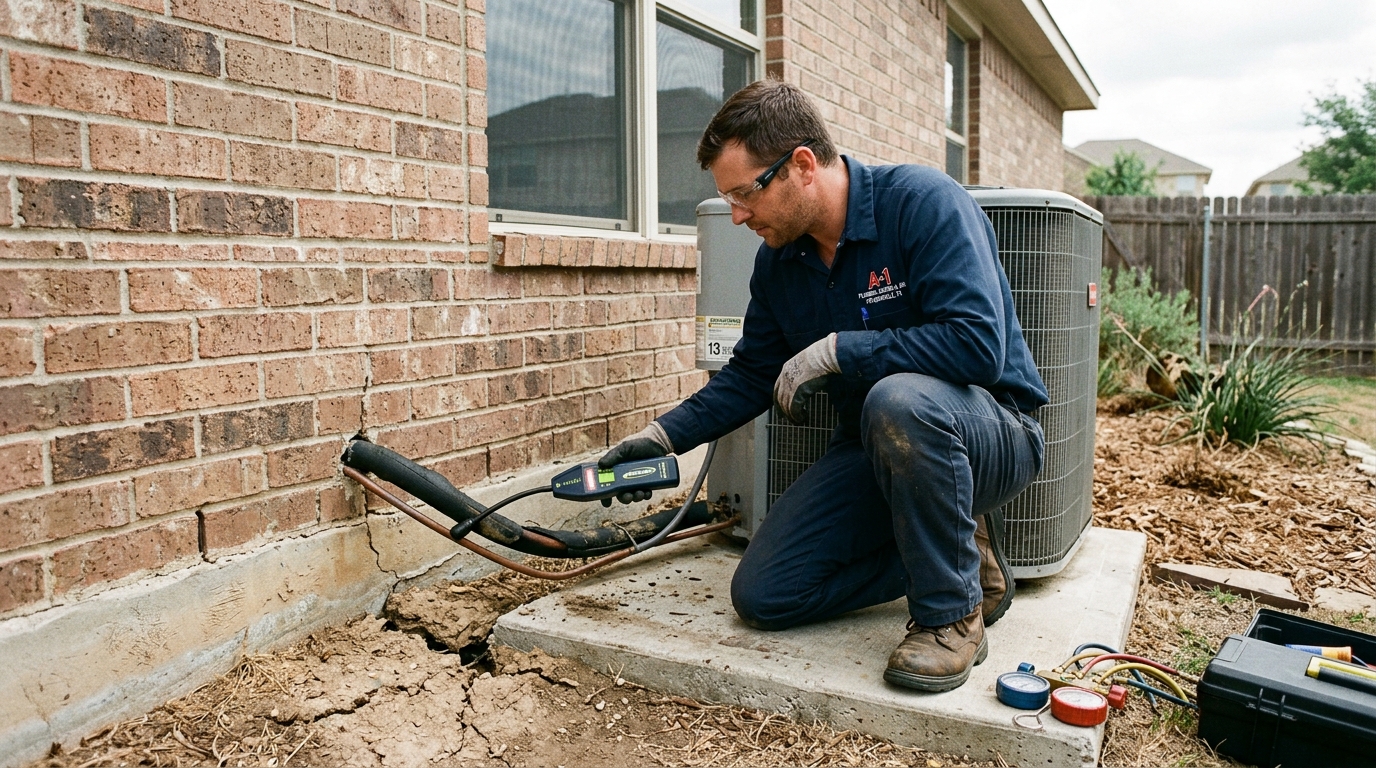
Expansive Soil Mechanics & Outdoor Condenser Pad Subsidence
Pflugerville sits atop expansive Taylor marl clay soils that swell during wet winters and shrink during summer droughts. This movement causes ground subsidence beneath equipment pads, tipping condensing units out of level and placing intense shear stress on brazed copper refrigerant piping.
Central Texas clay contains montmorillonite minerals that expand up to thirty percent when hydrated and contract sharply when dry.
During sustained summer droughts with 40 days above 100 degrees, soil around foundations pulls away and fissures deeply.
Heavy condensing units weighing 200 pounds begin tilting as concrete equipment pads settle unevenly into soil voids.
Neighborhoods along Heatherwilde Boulevard in Highland Park and Dessau Road frequently exhibit pronounced pad slope deviations.
Copper Suction Line Tension & Brazed Joint Shearing
As an outdoor condenser sinks away from an exterior wall, rigid copper refrigerant line-sets become taut. Continuous mechanical compressor vibration combined with tension forces shears delicate brazed service valves and line-set fittings, discharging pressurized R-410A refrigerant into the surrounding atmosphere.
Refrigerant line-sets enter homes through rigid masonry or brick veneer openings that do not accommodate vertical movement.
When ground pads drop two inches, copper tubing bends sharply against brick edges, causing fatigue pinhole leaks.
Homeowners typically notice the issue when their air conditioner runs constantly while blowing lukewarm air from supply vents.
Operating a compressor with depleted refrigerant causes internal overheating, electrical winding breakdown, and catastrophic mechanical seizure.
Electronic Leak Detection & Foundation Isolation Methods
Remediating soil-induced line-set failures requires electronic leak detection, nitrogen brazing, pad re-leveling, and flexible loops. Technicians pressurize copper lines with nitrogen, pinpoint leaks with ultrasonic detectors, and insert structural loop bends that absorb future seasonal soil movement without placing tension on copper joints.
Re-leveling settled equipment pads with crushed granite base material restores proper compressor oil circulation and prevents bearing wear.
Adding vibration-absorbing elastomeric expansion loops allows outdoor condensing units to settle slightly without stressing rigid wall penetrations.
Our licensed technicians provide comprehensive refrigerant leak remediation and pad stabilization through our emergency cooling repair service across Travis and Williamson counties.
Maintaining consistent foundation watering around exterior condenser pads with soaker hoses prevents severe clay contraction during heatwaves.
Frequently Asked Questions About Shifting Soils and HVAC Units
Central Texas homeowners frequently encounter outdoor air conditioning problems caused by severe ground movement during summer droughts. Below are practitioner answers explaining why clay soil damages equipment pads, how technicians locate refrigerant leaks in brick penetrations, and how to prevent costly piping fractures.
Why does Texas drought soil movement damage outdoor air conditioners?
Taylor marl clay contracts severely as moisture evaporates, creating deep soil fissures and uneven ground sinkage beneath concrete condenser pads. When the heavy unit tilts away from the foundation wall, tension pulls and shears rigid copper refrigerant line-sets connected to the home.
How do technicians find hidden refrigerant leaks in brick walls?
Technicians isolate the copper line-set, pressurize the system with high-pressure nitrogen and trace refrigerant, and scan pipe sleeves with heated-diode electronic detectors. Digital ultrasonic sniffers detect escaping high-frequency sound waves from tiny pinholes hidden inside masonry wall sleeves reliably and quickly.
What is the cost to re-level an unlevel condenser pad in Pflugerville?
Re-leveling an outdoor condenser pad typically costs $150 to $350 depending on whether composite shims, crushed gravel base packing, or complete equipment disconnection is required. Correcting pad tilt promptly prevents expensive line-set brazing repairs and catastrophic compressor oil starvation permanently.
Texas TDLR Class A licensed technicians dispatch 24/7 across 78660 with fully stocked service trucks and upfront diagnostic estimates.
🚨 DISPATCH LOCAL PFLUGERVILLE CREW: (512) 798-4822