Homeowners running room humidifiers during winter often wake up to discover a fine chalky powder coating dark furniture, television screens, and floors, wondering why their humidifier leaves white film on everything.
Many suspect ceiling drywall breakdown or smoke soot. However, this phenomenon almost always stems from the interaction between ultrasonic humidifier technology and hard municipal tap water.
Why Ultrasonic Humidifiers Create White Powder Residue
Humidifier technology falls into two primary categories: warm mist evaporative units and cool mist ultrasonic units.
Evaporative and steam humidifiers leave mineral scaling behind inside the reservoir heating chamber or paper wick, releasing only pure water vapor into the surrounding atmosphere.
In contrast, ultrasonic nebulizers propel liquid water droplets directly into the air. Once airborne, the liquid evaporates within seconds, leaving behind millions of airborne mineral crystals.
The Central Texas Hard Water Connection: Edwards Limestone Minerals
The geological landscape of Central Texas consists largely of limestone bedrock and calcium carbonate deposits. Municipal water supplies naturally dissolve these alkaline minerals.
During winter months, local residents run humidifiers continuously to alleviate nasal dryness caused by mountain cedar fever and winter heating cycles.
A standard single-gallon ultrasonic humidifier filled with local tap water can pump over 1.5 grams of mineral powder into a bedroom every night, rapidly settling onto nearby surfaces.
Health Implications: Is Humidifier Mineral Dust Dangerous?
The Environmental Protection Agency (EPA) has studied ultrasonic humidifier emissions and recommends minimizing mineral dispersion in enclosed residential rooms.
When minerals are aerosolized, they do not remain on tables. They float suspended in the air current, matching the size profile of harmful particulate matter.
Furthermore, uncleaned humidifier reservoirs can harbor bacteria and mold spores, which bind to mineral dust particles and travel directly into occupant respiratory tracts.
How Humidifier Dust Clogs HVAC Filters and Strains Equipment
Most homeowners do not realize that portable room humidifiers directly affect their central heating and cooling infrastructure.
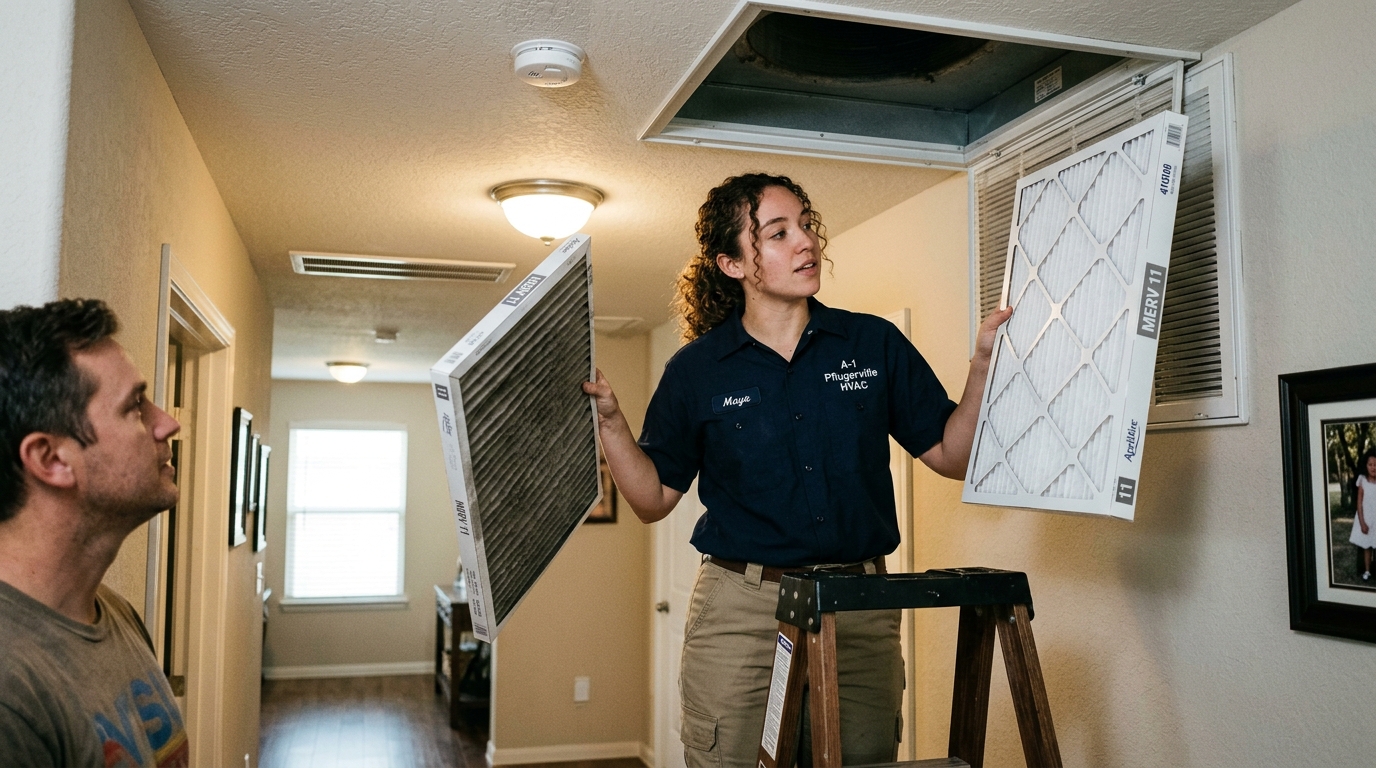
HVAC return vents actively vacuum indoor air. As fine calcium powder passes through return ducts, it embeds into pleated filter media, forming a dense white barrier.
Suffocated airflow prevents the gas furnace heat exchanger from cooling down properly during winter, forcing safety limit switches to cycle repeatedly until the control board initiates a full lockout.
Scheduling a seasonal HVAC safety tune-up ensures that blower wheels and evaporator coils are chemically cleaned of mineral accumulation before summer loads arrive.
Experiencing Furnace Lockouts or Reduced Airflow?
Our Pflugerville diagnostic technicians measure static pressure, clean fouled blower assemblies, and inspect heat exchangers for thermal stress cracks.
Call for Professional Service: (888) 217-8281How to Eliminate White Dust Completely: 3 Proven Solutions
Resolving white dust requires addressing water chemistry or changing the humidification mechanism altogether.
Using reverse osmosis (RO) or commercially distilled water provides immediate relief for existing ultrasonic units, ensuring that only pure vapor enters the room.
Alternatively, installing a whole-home bypass evaporative humidifier directly onto your central furnace supply plenum delivers balanced indoor humidity without producing any airborne mineral dust.
Frequently Asked Questions About Humidifier White Dust
What is the white dust produced by a humidifier?
Because ultrasonic vibrations bypass the boiling process, minerals remain completely intact as tiny aerosolized crystalline particles.
Is white dust from a humidifier harmful to breathe?
Switching to demineralized water immediately eliminates particulate exposure and keeps indoor air clean and breathable.
Does humidifier white dust damage HVAC systems and air filters?
Homeowners using ultrasonic humidifiers should inspect their pleated air filters monthly to prevent severe static pressure spikes.
How do you stop white dust from coming out of a humidifier?
Many ultrasonic manufacturers also offer drop-in ion-exchange demineralization cartridges designed to capture dissolved calcium before mist ejection.
Improve Your Indoor Air Quality in Pflugerville
From whole-home humidification to whole-home filtration and duct balancing, our TDLR-certified team ensures healthy, breathable comfort in every room.
Schedule IAQ Consultation: (888) 217-8281